
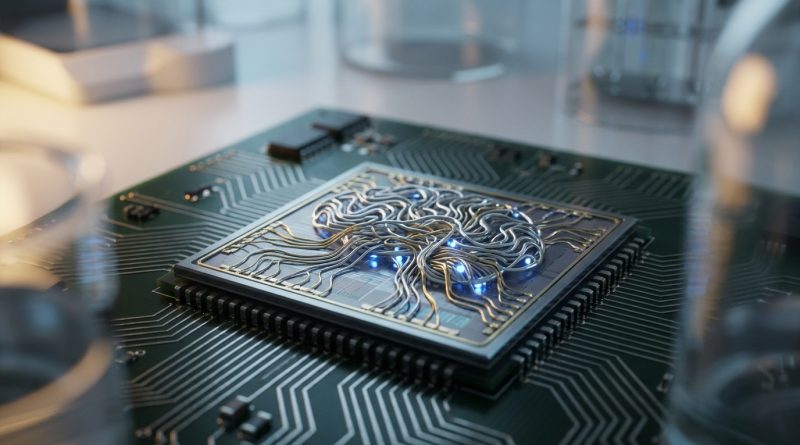
Neuromorphic Computing for Energy-Efficient Data Centers
Let’s be honest for a second. Data centers are hungry. Not just a little peckish — they’re like a teenager raiding the fridge at 2 AM, except the fridge is the power grid and the teenager never sleeps. In fact, some estimates suggest data centers could consume up to 8% of global electricity by 2030. That’s a lot of juice for moving cat videos and processing spreadsheets.
But here’s the thing. The way we’ve built computers for the last 70 years — with separate memory and processing units shuttling data back and forth like a game of hot potato — is fundamentally wasteful. Every time you move a piece of data, you burn energy. And we move a lot of data. So what if we flipped the script? What if we built chips that work more like… well, a brain?
That’s the promise of neuromorphic computing. It’s not just a buzzword. It’s a genuine shift in how we think about computation, and it might just be the lifeline data centers need.
What Exactly Is Neuromorphic Computing?
Okay, so imagine your typical computer. It’s got a CPU, some RAM, and a hard drive. To do anything — say, add two numbers — it has to fetch the numbers from memory, move them to the processor, crunch them, then send the result back. That constant back-and-forth is called the “von Neumann bottleneck,” and it’s a massive energy drain.
Neuromorphic chips, on the other hand, ditch that architecture entirely. They’re designed to mimic the structure of biological neurons and synapses. Instead of a central processor, you have thousands — sometimes millions — of tiny processing units that are also memory. They compute and store in the same place. It’s like having a million tiny brains all working in parallel, rather than one big brain passing notes to itself.
The key player here is something called a “spiking neural network” (SNN). Unlike traditional neural networks that fire constantly, SNNs only activate when they need to — just like real neurons. They send a spike of electricity only when a threshold is crossed. No spike, no energy use. It’s event-driven, not clock-driven. That alone can cut energy consumption by orders of magnitude.
Why Data Centers Are Desperate for a Change
Here’s the deal. Data centers aren’t just running your email. They’re training massive AI models, processing real-time analytics, streaming video, and running cloud gaming. All of that requires serious compute. And the demand isn’t slowing down — it’s accelerating.
But there’s a catch. Traditional chips are hitting physical limits. You can’t just keep shrinking transistors forever — we’re already at the atomic scale. And as chips get denser, they get hotter. Cooling costs are skyrocketing. In fact, for every watt of power used for computing, you often need another watt just to cool the damn thing. That’s a brutal equation.
Neuromorphic chips flip that equation. Because they’re so energy-efficient, they generate far less heat. That means less cooling, lower operational costs, and a smaller carbon footprint. It’s not a marginal improvement — it’s a paradigm shift.
The Real-World Numbers (and They’re Staggering)
Let’s get concrete. Intel’s Loihi 2 chip, one of the most advanced neuromorphic processors, runs certain inference tasks using up to 100x less energy than traditional GPUs. IBM’s TrueNorth chip, a few years back, achieved a similar feat — it could recognize images with roughly 1/10,000th of the power of a conventional system. Those aren’t typo’s. That’s real.
But here’s where it gets interesting for data centers. A study from Sandia National Labs found that neuromorphic systems could handle pattern recognition and anomaly detection tasks — think cybersecurity monitoring or fraud detection — with 50-90% less energy than current server hardware. For a hyperscale facility running tens of thousands of servers, that’s not just a cost saving. It’s a survival strategy.
Where Neuromorphic Shines (and Where It Doesn’t)
Now, let’s not get carried away. Neuromorphic isn’t a silver bullet. It’s not going to replace your GPU for training enormous language models — not yet, anyway. The precision just isn’t there. But for a whole class of tasks, it’s actually better than traditional hardware.
Perfect Use Cases for Neuromorphic in Data Centers
- Real-time anomaly detection: Monitoring thousands of server metrics for unusual patterns. Neuromorphic chips excel at this because they’re naturally good at spotting outliers in noisy data streams.
- Edge inference: For IoT devices and edge servers that run on battery or solar, neuromorphic is a godsend. It can do vision, audio, and sensor processing with minimal power draw.
- Dynamic resource allocation: Figuring out which server should handle which task, in real-time, based on current load. It’s a combinatorial optimization problem — right in the sweet spot for neuromorphic.
- Predictive maintenance: Analyzing vibration, temperature, and power usage patterns to predict hardware failures before they happen. The brain-like architecture handles temporal data beautifully.
Where It Falls Short (For Now)
- High-precision math: If you need 64-bit floating point accuracy for scientific simulations, neuromorphic isn’t your friend. It works in analog-ish spikes, not exact numbers.
- Software maturity: The toolchain is still young. You can’t just run PyTorch on a neuromorphic chip yet — you need specialized frameworks like Intel’s Lava or IBM’s SNN Toolbox.
- Legacy integration: Data centers run x86 software stacks. Moving to neuromorphic requires a hybrid approach — at least initially.
That said, the trajectory is clear. Every year, the software gets better, and the hardware gets more capable. The gap is closing.
The Hybrid Data Center: A Realistic Path Forward
So, what does this actually look like in practice? Well, no one’s ripping out their servers tomorrow. The realistic path is a hybrid architecture. You keep your traditional CPUs and GPUs for heavy lifting — training models, running databases, compiling code. But you add a bank of neuromorphic accelerators for the tasks that don’t need brute force.
Think of it like a kitchen. You’ve got your industrial oven (GPU) for roasting big turkeys. But you also have a microwave (neuromorphic) for quick reheats. You don’t fire up the oven for a cup of coffee. Why would you use a 400-watt GPU to detect whether a server is running hot?
This hybrid model could cut total data center energy consumption by 30-40% without sacrificing performance. That’s not a pipe dream — companies like BrainChip and SynSense are already shipping commercial neuromorphic chips. And major cloud providers are quietly testing them in their labs. You know, just in case.
A Quick Comparison: Traditional vs. Neuromorphic
| Aspect | Traditional CPU/GPU | Neuromorphic Chip |
|---|---|---|
| Architecture | Von Neumann (separate memory & processor) | Brain-inspired (memory and compute co-located) |
| Energy per operation | High (nanjoules to microjoules) | Ultra-low (picojoules to femtojoules) |
| Best at | Precision math, general-purpose tasks | Pattern recognition, real-time inference, optimization |
| Heat generation | Significant (requires heavy cooling) | Minimal (often passively cooled) |
| Programming model | Mature (Python, C++, CUDA) | Emerging (SNN frameworks, custom languages) |
| Scalability | Proven at hyperscale | Still in early adoption |
See the tradeoff? It’s not about which is “better” — it’s about using the right tool for the right job.
The Environmental Angle (Because We Can’t Ignore It)
Here’s a sobering thought. If data centers were a country, they’d rank 5th in the world for electricity demand — right behind Japan. That’s insane. And with AI’s insatiable appetite for compute, that number is only going up. Companies are scrambling to meet net-zero pledges, but renewable energy alone won’t cut it. You also need to use less energy, period.
Neuromorphic computing isn’t just a nice-to-have. It’s a way to keep growing without cooking the planet. And honestly, the fact that we can mimic the brain’s efficiency — which runs on about 20 watts, by the way — is a little humbling. Your brain does more computation in a second than a supercomputer does in a day, using less power than a dim lightbulb.
We’ve got a long way to go to match that. But every step toward neuromorphic is a step in the right direction.
What’s Holding Us Back? (And What’s Pushing Us Forward)
Sure, there are hurdles. The biggest one? Software ecosystems. Developers are used to writing code for CPUs and GPUs. Switching to a spiking neural network paradigm feels like learning a new language — because it is. But the momentum is building. Intel’s Lava framework, IBM’s research, and a growing open-source community are making it easier every day.
Another hurdle is standardization. There’s no universal neuromorphic chip yet. Loihi, TrueNorth, BrainChip’s Akida — they all have different architectures and different quirks. That’s normal for an emerging technology, but it makes enterprise adoption risky. No one wants to bet the farm on a chip that might be obsolete in two years.
But the push? It’s strong. The economics are undeniable. When you can cut power consumption by 100x for certain workloads, the ROI math works out fast. And as chip fabs mature their neuromorphic processes, costs will drop. It’s the classic technology adoption curve — early adopters take the risk, then everyone else follows.
The Bottom Line: This Isn’t Sci-Fi Anymore
Look, I get it. “Neuromorphic” sounds like something out of a cyberpunk novel. But it’s real, it’s here, and it’s quietly making its way into the